Article Sidebar
Main Article Content
Abstract
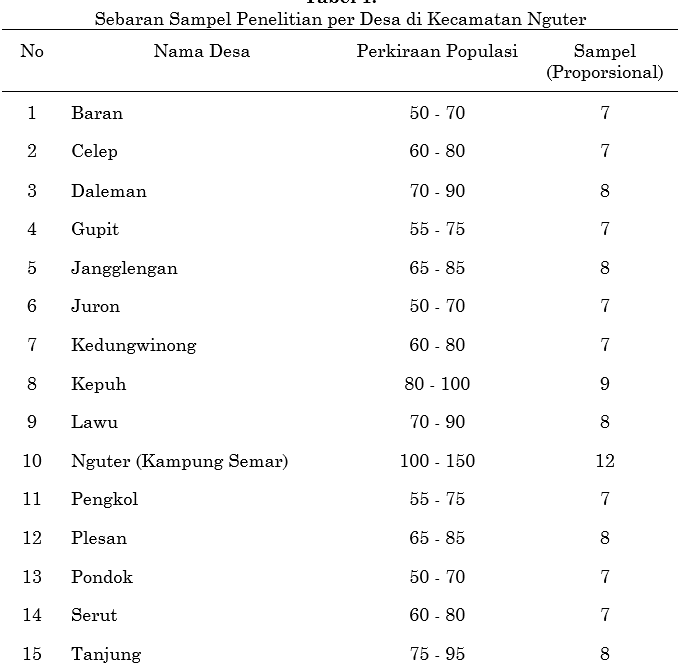
Sentra Industri Jamu Nguter di Sukoharjo merupakan kawasan produksi jamu tradisional dengan sejarah yang panjang. Masyarakat setempat menghadapi tantangan dalam menyeimbangkan peningkatan kualitas talenta dengan pelestarian kearifan lokal di era digital. Penelitian ini bertujuan untuk mengukur pengaruh kualitas talenta terhadap efektivitas pelestarian kearifan lokal. Metode penelitian menggunakan pendekatan kuantitatif dengan desain survei cross-sectional terhadap 120 responden yang tersebar di 16 desa. Instrumen penelitian berupa kuesioner skala Likert yang mengukur enam variabel independen dan dua variabel dummy. Teknik analisis data menggunakan statistik deskriptif dan regresi linier berganda. Hasil penelitian menunjukkan bahwa partisipasi pelatihan, keterampilan digital, status usaha modern, pendidikan formal, dan inovasi produk berpengaruh positif dan signifikan terhadap pelestarian kearifan lokal. Model regresi memiliki kemampuan prediksi yang sangat baik dalam menjelaskan variasi pelestarian tradisi. Penelitian ini menyimpulkan bahwa peningkatan kualitas talenta tidak mengancam, melainkan memperkuat pelestarian kearifan lokal. Implikasi penelitian merekomendasikan program pelatihan berbasis kearifan lokal, fasilitasi perizinan usaha, serta pengembangan pemasaran digital yang tetap menjunjung autentisitas produk.
Keywords
Article Details
Copyright (c) 2026 Norbertus Citra Irawan, Raniasari Bimanti Esthi, Mahananto, Zandra Dwanita Widodo, Etty Zuliawati Zed, Sinta Sundari Heriyanti, Sindik Widati, Wahyu Widayat

This work is licensed under a Creative Commons Attribution 4.0 International License.
References
- Adiguna, P., Sutariyono, S., Aisha, N., Herawati, T., Nurrahman, S., Saefullah, A., AR, R., Hakim, M. P., Syaputra, R., & Sitohang, R. M. (2024). Pelatihan dan Pengembangan Sumber Daya Manusia pada UMKM Melalui Keterampilan Digital dalam Produksi Pangan. Journal of Community Research & Engagement, 1(1), 92–102. https://doi.org/10.60023/v1sgmx97
- Andriani, H., Friska, E., Arsyi, M., Sutrisno, A. E., Waits, A., & Rahmawati, N. D. (2023). A multilevel analysis of the triple burden of malnutrition in Indonesia: trends and determinants from repeated cross-sectional surveys. BMC Public Health, 23(1), 1836. https://doi.org/10.1186/s12889-023-16728-y
- Astuti, E. D., & Utsman, U. (2021). Pemberdayaan Masyarakat Melalui Pembuatan Jamu Tradisional Dalam Meningkatkan Kesejahteraan Di Kampung Jamu Nguter Kabupaten Sukoharjo. Lifelong Education Journal, 1(1), 35–42. https://doi.org/10.59935/lej.v1i1.14
- Becker, G. S. (1964). Human Capital: A Theoretical and Empirical Analysis, with Special Reference to Education. Columbia University Press.
- David, P. A. (1985). Clio and the Economics of QWERTY. American Economic Review, 75(2), 332–337.
- Devi, P., & Kumar, P. (2024). Challenges in the Storage of Herbal Medicine Products and Strategies for Sustainable Management. In Reference Series in Phytochemistry (pp. 1739–1767). https://doi.org/10.1007/978-3-031-43199-9_37
- Farida. (2021). Dari Nguter Jamu Menyebar. Jamupedia.Com. https://jamupedia.com/liputankhusus/dari-nguter-jamu-menyebar/
- Floris, M., Pinna, R., & Veglianti, E. (2025). Unveiling gender disparities in male-dominated industries: An intersectional perspective. In Feminist Perspectives in Business Studies (pp. 171–196). Edward Elgar Publishing. https://doi.org/10.4337/9781035336005.00016
- Fogliato, R., Patil, P., Monfort, M., & Perona, P. (2025). A Framework for Efficient Model Evaluation Through Stratification, Sampling, and Estimation. In Lecture Notes in Computer Science (pp. 140–158). https://doi.org/10.1007/978-3-031-73223-2_9
- Gardjito, M., Harmayani, E., & Suharjono, K. I. (2018). Jamu Pusaka Penjaga Kesehatan Bangsa Asli Indonesia. UGM Press.
- Hao, Y., Song, J., & Shen, Z. (2022). Does industrial agglomeration affect the regional environment? Evidence from Chinese cities. Environmental Science and Pollution Research, 29(5), 7811–7826. https://doi.org/10.1007/s11356-021-16023-6
- Hodgson, G. M. (2025). Formal and informal institutions: some problems of meaning, impact, and interaction. Journal of Institutional Economics, 21, e1. https://doi.org/10.1017/S1744137424000249
- Inkeles, A., & Smith, D. H. (1974). Becoming Modern: Individual Change in Six Developing Countries. Harvard University Press.
- Irawan, N. C., Darmaningrum, K., Widodo, Z. D., Putranto, R. R., & Hanifah, S. A. (2024). Pengaruh Pengetahuan Hijau dan Religiusitas Terhadap Eco-Inovasi Produk Berbahan Baku Etnobotani Lokal. Jurnal Agroindustri Halal, 10(1), 33–44. https://doi.org/10.30997/jah.v10i1.10127
- Jarvis, D., Stoeckl, N., Larson, S., Grainger, D., Addison, J., & Larson, A. (2021). The Learning Generated Through Indigenous Natural Resources Management Programs Increases Quality of Life for Indigenous People – Improving Numerous Contributors to Wellbeing. Ecological Economics, 180, 106899. https://doi.org/10.1016/j.ecolecon.2020.106899
- Kadaruddin, Baso, Y. S., Gusnawaty, Hasjim, M., & Hasyim, M. (2023). Challenges and Existence of the Mekongga Local Language as a Media for Preserving Local Wisdom. International Journal of Membrane Science and Technology, 10(3), 1779–1785. https://doi.org/10.15379/ijmst.v10i3.1801
- Kariveliparambil, A., Rasi, R. A., Ahmad, M. S., Öztaş, N., & Ayan, F. S. (2026). Evolving Social Capital in Indigenous Communities: Perspectives on Trust, Reciprocity, and Cultural Preservation Among Irula Elders. Journal of Social Service Research, 52(1), 147–166. https://doi.org/10.1080/01488376.2025.2579519
- Karpyak, M. O., & Horbova, K. V. (2022). Preservation of human potential as the main strategic resource for the development of the regions of Ukraine in the conditions of Russian aggression. Regional Economy, 2(104), 57–62. https://doi.org/10.36818/1562-0905-2022-2-6
- Khoa, B. T., Hung, B. P., & Brahmi, M. H. (2023). Qualitative research in social sciences: data collection, data analysis and report writing. International Journal of Public Sector Performance Management, 12(1/2), 187–209. https://doi.org/10.1504/IJPSPM.2023.132247
- Kong, L. (2026). Leveraging social media to promote ceramic craftsmanship: pathways to inclusive growth in rural China. Digital Creativity, 37(2), 188–206. https://doi.org/10.1080/14626268.2026.2618274
- Konimex. (2019). Kafe Jamu Sukoharjo, Kafe Jamu Pertama di Indonesia. Konimex.Com. https://www.konimex.com/post/news-from-konimex/kafe-jamu-sukoharjo-kafe-jamu-pertama-di-indonesia
- Kurniawan, A. (2025). Bridging tradition and science: the health-promoting potentials of Indonesian local spices in ethnic foods. Journal of Ethnic Foods, 12(1), 39. https://doi.org/10.1186/s42779-025-00299-x
- Miao, C., & Guoming, D. (2024). Enhancing Rural Revitalization: A Study on the Creative Transformation of Agricultural Heritage among Ethnic Minorities in Heilongjiang, China. Journal of Resources and Ecology, 15(6). https://doi.org/10.5814/j.issn.1674-764x.2024.06.014
- Mikhaleva, E. P., Vasin, A. S., Sorvina, O. V., Shul’zhenko, N. A., & Malikov, B. A. (2025). Designing new approaches to the development of the region’s human resources potential in modern conditions. Regional Economics Theory and Practice, 170. https://doi.org/10.24891/bgfjrw
- Niessen, L., Bocken, N. M. P., & Dijk, M. (2023). Sufficiency as trend or tradition?—Uncovering business pathways to sufficiency through historical advertisements. Frontiers in Sustainability, 4. https://doi.org/10.3389/frsus.2023.1165682
- North, D. C. (1990). Institutions, Institutional Change and Economic Performance. Cambridge University Press.
- Nugroho, K. A. (2025). An Efficient Sampling Approach for Village Elections: Quick Count Using Stratified Systematic Cluster Sampling. IJIIS: International Journal of Informatics and Information Systems, 8(1), 22–32. https://doi.org/10.47738/ijiis.v8i1.245
- Perbawasari, S., Subekti, P., & Setyanto, Y. (2024). Strategies for Herbal Knowledge Inheritance Through Non-Formal Education in Traditional Villages. Jurnal Komunikasi, 16(1), 205–225. https://doi.org/10.24912/jk.v16i1.29048
- Permatasari, M. A., Astuti, T. M. P., Setyowati, D. L., & Abbas, E. W. (2025). Values of Local Wisdom and Sasirangan Tourism in The City of Banjarmasin, South Kalimantan, Indonesia. Journal of Ecohumanism, 4(1). https://doi.org/10.62754/joe.v4i1.6270
- Polanyi, M. (1966). The Tacit Dimension. Doubleday & Co.
- Rennó, R., & Novaes, J. (2024). Community Networks as Sustainable Infrastructure for Digital Skills. In Digital Literacy and Inclusion (pp. 161–176). Springer International Publishing. https://doi.org/10.1007/978-3-031-30808-6_11
- Wang, H., Chen, Y., Wang, L., Liu, Q., Yang, S., & Wang, C. (2023). Advancing herbal medicine: enhancing product quality and safety through robust quality control practices. Frontiers in Pharmacology, 14. https://doi.org/10.3389/fphar.2023.1265178
- Wang, X., & Zhu, Q. (2022). Influencing Factors of Traditional Village Protection and Development from the Perspective of Resilience Theory. Land, 11(12), 2314. https://doi.org/10.3390/land11122314
- Yunita, F., Gunawan, S., Silaban, H., & Chaidir. (2024). The journey of Indonesian traditional medicine. Tarumanagara Medical Journal, 6(2), 241–252. https://doi.org/10.24912/tmj.v6i2.33351
- Zaini, R., & Ismail, K. (2024). Harnessing Indonesian Local Wisdom for Innovative Tourism Development in the Creative Economy. International Journal of Accounting and Management Research, 5(2), 57–66. https://doi.org/10.30741/ijamr.v5i2.1405
- Zhu, H. (2024). The Application Analysis of Regional Cultural Traditions in Rural Revitalization. International Journal of Education and Humanities, 13(1), 126–129. https://doi.org/10.54097/ny9mb724
References
Adiguna, P., Sutariyono, S., Aisha, N., Herawati, T., Nurrahman, S., Saefullah, A., AR, R., Hakim, M. P., Syaputra, R., & Sitohang, R. M. (2024). Pelatihan dan Pengembangan Sumber Daya Manusia pada UMKM Melalui Keterampilan Digital dalam Produksi Pangan. Journal of Community Research & Engagement, 1(1), 92–102. https://doi.org/10.60023/v1sgmx97
Andriani, H., Friska, E., Arsyi, M., Sutrisno, A. E., Waits, A., & Rahmawati, N. D. (2023). A multilevel analysis of the triple burden of malnutrition in Indonesia: trends and determinants from repeated cross-sectional surveys. BMC Public Health, 23(1), 1836. https://doi.org/10.1186/s12889-023-16728-y
Astuti, E. D., & Utsman, U. (2021). Pemberdayaan Masyarakat Melalui Pembuatan Jamu Tradisional Dalam Meningkatkan Kesejahteraan Di Kampung Jamu Nguter Kabupaten Sukoharjo. Lifelong Education Journal, 1(1), 35–42. https://doi.org/10.59935/lej.v1i1.14
Becker, G. S. (1964). Human Capital: A Theoretical and Empirical Analysis, with Special Reference to Education. Columbia University Press.
David, P. A. (1985). Clio and the Economics of QWERTY. American Economic Review, 75(2), 332–337.
Devi, P., & Kumar, P. (2024). Challenges in the Storage of Herbal Medicine Products and Strategies for Sustainable Management. In Reference Series in Phytochemistry (pp. 1739–1767). https://doi.org/10.1007/978-3-031-43199-9_37
Farida. (2021). Dari Nguter Jamu Menyebar. Jamupedia.Com. https://jamupedia.com/liputankhusus/dari-nguter-jamu-menyebar/
Floris, M., Pinna, R., & Veglianti, E. (2025). Unveiling gender disparities in male-dominated industries: An intersectional perspective. In Feminist Perspectives in Business Studies (pp. 171–196). Edward Elgar Publishing. https://doi.org/10.4337/9781035336005.00016
Fogliato, R., Patil, P., Monfort, M., & Perona, P. (2025). A Framework for Efficient Model Evaluation Through Stratification, Sampling, and Estimation. In Lecture Notes in Computer Science (pp. 140–158). https://doi.org/10.1007/978-3-031-73223-2_9
Gardjito, M., Harmayani, E., & Suharjono, K. I. (2018). Jamu Pusaka Penjaga Kesehatan Bangsa Asli Indonesia. UGM Press.
Hao, Y., Song, J., & Shen, Z. (2022). Does industrial agglomeration affect the regional environment? Evidence from Chinese cities. Environmental Science and Pollution Research, 29(5), 7811–7826. https://doi.org/10.1007/s11356-021-16023-6
Hodgson, G. M. (2025). Formal and informal institutions: some problems of meaning, impact, and interaction. Journal of Institutional Economics, 21, e1. https://doi.org/10.1017/S1744137424000249
Inkeles, A., & Smith, D. H. (1974). Becoming Modern: Individual Change in Six Developing Countries. Harvard University Press.
Irawan, N. C., Darmaningrum, K., Widodo, Z. D., Putranto, R. R., & Hanifah, S. A. (2024). Pengaruh Pengetahuan Hijau dan Religiusitas Terhadap Eco-Inovasi Produk Berbahan Baku Etnobotani Lokal. Jurnal Agroindustri Halal, 10(1), 33–44. https://doi.org/10.30997/jah.v10i1.10127
Jarvis, D., Stoeckl, N., Larson, S., Grainger, D., Addison, J., & Larson, A. (2021). The Learning Generated Through Indigenous Natural Resources Management Programs Increases Quality of Life for Indigenous People – Improving Numerous Contributors to Wellbeing. Ecological Economics, 180, 106899. https://doi.org/10.1016/j.ecolecon.2020.106899
Kadaruddin, Baso, Y. S., Gusnawaty, Hasjim, M., & Hasyim, M. (2023). Challenges and Existence of the Mekongga Local Language as a Media for Preserving Local Wisdom. International Journal of Membrane Science and Technology, 10(3), 1779–1785. https://doi.org/10.15379/ijmst.v10i3.1801
Kariveliparambil, A., Rasi, R. A., Ahmad, M. S., Öztaş, N., & Ayan, F. S. (2026). Evolving Social Capital in Indigenous Communities: Perspectives on Trust, Reciprocity, and Cultural Preservation Among Irula Elders. Journal of Social Service Research, 52(1), 147–166. https://doi.org/10.1080/01488376.2025.2579519
Karpyak, M. O., & Horbova, K. V. (2022). Preservation of human potential as the main strategic resource for the development of the regions of Ukraine in the conditions of Russian aggression. Regional Economy, 2(104), 57–62. https://doi.org/10.36818/1562-0905-2022-2-6
Khoa, B. T., Hung, B. P., & Brahmi, M. H. (2023). Qualitative research in social sciences: data collection, data analysis and report writing. International Journal of Public Sector Performance Management, 12(1/2), 187–209. https://doi.org/10.1504/IJPSPM.2023.132247
Kong, L. (2026). Leveraging social media to promote ceramic craftsmanship: pathways to inclusive growth in rural China. Digital Creativity, 37(2), 188–206. https://doi.org/10.1080/14626268.2026.2618274
Konimex. (2019). Kafe Jamu Sukoharjo, Kafe Jamu Pertama di Indonesia. Konimex.Com. https://www.konimex.com/post/news-from-konimex/kafe-jamu-sukoharjo-kafe-jamu-pertama-di-indonesia
Kurniawan, A. (2025). Bridging tradition and science: the health-promoting potentials of Indonesian local spices in ethnic foods. Journal of Ethnic Foods, 12(1), 39. https://doi.org/10.1186/s42779-025-00299-x
Miao, C., & Guoming, D. (2024). Enhancing Rural Revitalization: A Study on the Creative Transformation of Agricultural Heritage among Ethnic Minorities in Heilongjiang, China. Journal of Resources and Ecology, 15(6). https://doi.org/10.5814/j.issn.1674-764x.2024.06.014
Mikhaleva, E. P., Vasin, A. S., Sorvina, O. V., Shul’zhenko, N. A., & Malikov, B. A. (2025). Designing new approaches to the development of the region’s human resources potential in modern conditions. Regional Economics Theory and Practice, 170. https://doi.org/10.24891/bgfjrw
Niessen, L., Bocken, N. M. P., & Dijk, M. (2023). Sufficiency as trend or tradition?—Uncovering business pathways to sufficiency through historical advertisements. Frontiers in Sustainability, 4. https://doi.org/10.3389/frsus.2023.1165682
North, D. C. (1990). Institutions, Institutional Change and Economic Performance. Cambridge University Press.
Nugroho, K. A. (2025). An Efficient Sampling Approach for Village Elections: Quick Count Using Stratified Systematic Cluster Sampling. IJIIS: International Journal of Informatics and Information Systems, 8(1), 22–32. https://doi.org/10.47738/ijiis.v8i1.245
Perbawasari, S., Subekti, P., & Setyanto, Y. (2024). Strategies for Herbal Knowledge Inheritance Through Non-Formal Education in Traditional Villages. Jurnal Komunikasi, 16(1), 205–225. https://doi.org/10.24912/jk.v16i1.29048
Permatasari, M. A., Astuti, T. M. P., Setyowati, D. L., & Abbas, E. W. (2025). Values of Local Wisdom and Sasirangan Tourism in The City of Banjarmasin, South Kalimantan, Indonesia. Journal of Ecohumanism, 4(1). https://doi.org/10.62754/joe.v4i1.6270
Polanyi, M. (1966). The Tacit Dimension. Doubleday & Co.
Rennó, R., & Novaes, J. (2024). Community Networks as Sustainable Infrastructure for Digital Skills. In Digital Literacy and Inclusion (pp. 161–176). Springer International Publishing. https://doi.org/10.1007/978-3-031-30808-6_11
Wang, H., Chen, Y., Wang, L., Liu, Q., Yang, S., & Wang, C. (2023). Advancing herbal medicine: enhancing product quality and safety through robust quality control practices. Frontiers in Pharmacology, 14. https://doi.org/10.3389/fphar.2023.1265178
Wang, X., & Zhu, Q. (2022). Influencing Factors of Traditional Village Protection and Development from the Perspective of Resilience Theory. Land, 11(12), 2314. https://doi.org/10.3390/land11122314
Yunita, F., Gunawan, S., Silaban, H., & Chaidir. (2024). The journey of Indonesian traditional medicine. Tarumanagara Medical Journal, 6(2), 241–252. https://doi.org/10.24912/tmj.v6i2.33351
Zaini, R., & Ismail, K. (2024). Harnessing Indonesian Local Wisdom for Innovative Tourism Development in the Creative Economy. International Journal of Accounting and Management Research, 5(2), 57–66. https://doi.org/10.30741/ijamr.v5i2.1405
Zhu, H. (2024). The Application Analysis of Regional Cultural Traditions in Rural Revitalization. International Journal of Education and Humanities, 13(1), 126–129. https://doi.org/10.54097/ny9mb724